

Seabird nesting colonies in Cayo Frances Wildlife Refuge, Cuba
Article Sidebar
Main Article Content
Abstract
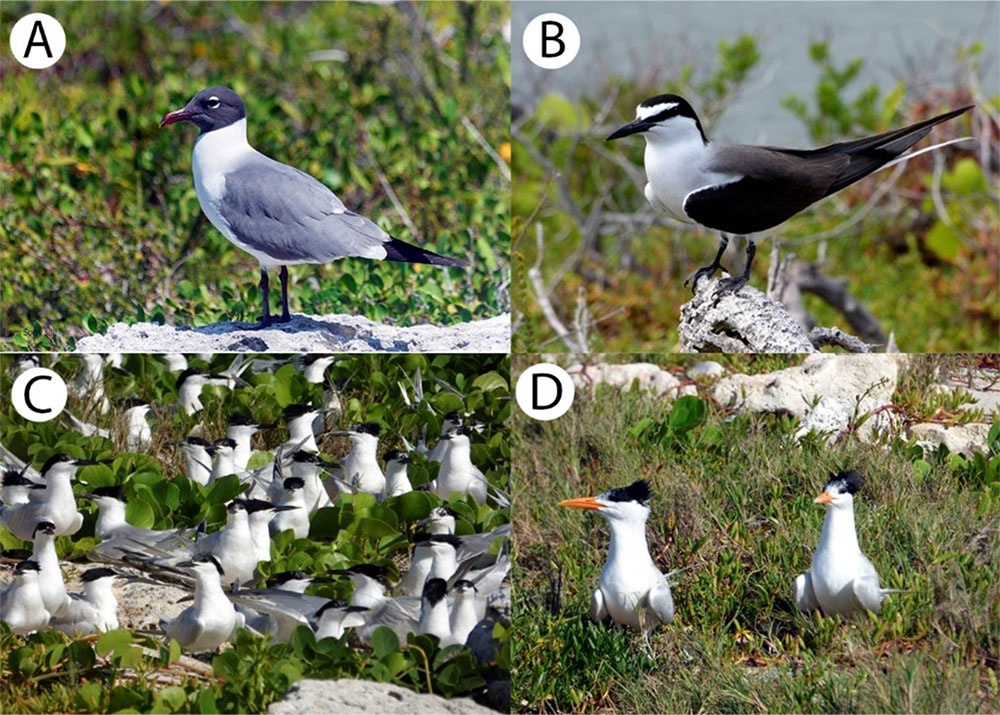
The study of seabird nesting colonies in Sabana-Camaguey Archipelago is crucial due to its relevance as a breeding area and the increasing threat of tourism development. Between 2006 and 2025, nine censuses were conducted in Cayo Español de Afuera (Cayo Frances Wildlife Refuge, northeast of Villa Clara Province, Cuba) with the aim of documenting aspects related to seabird nesting colonies (Charadriiformes). Given the small size of the key, a census was conducted during each visit, recording the presence of bird species and their breeding status. The number of nests, as well as their composition was determined for each species. As a result of the study, it was possible to corroborate the importance of Cayo Español de Afuera for the reproduction of several colonial seabirds, mainly for the Laughing Gull (Leucophaeus atricilla) and the Bridled Tern (Onychoprion anaethetus), as well as the most important period during the breeding season. In 2010, a nest belonging to the American Oystercatcher (Haematopus palliatus) was found, which constitutes the second documented nesting record for the species, in chronological order. The results demonstrate the need to continue ecological studies and monitoring bird colonies in these critical areas, increasing sampling efforts during each breeding season, in order to gain a more profound understanding of the process, thus contributing to the conservation of the species involved. Monitoring efforts must be concentrated between the second half of May and the beginning of June, given a lack of resources for conducting samplings.
Downloads
Article Details

This work is licensed under a Creative Commons Attribution-NonCommercial 4.0 International License.
Those authors who have publications with this journal accept the following terms of the License Attribution-NonCommercial-ShareAlike 4.0 International (CC BY-NC-SA 4.0):
You are free to:
- Share — copy and redistribute the material in any medium or format
- Adapt — remix, transform, and build upon the material
- The licensor cannot revoke these freedoms as long as you follow the license terms.
Under the following terms:
- Attribution — You must give appropriate credit , provide a link to the license, and indicate if changes were made . You may do so in any reasonable manner, but not in any way that suggests the licensor endorses you or your use.
- NonCommercial — You may not use the material for commercial purposes .
- ShareAlike — If you remix, transform, or build upon the material, you must distribute your contributions under the same license as the original.
- No additional restrictions — You may not apply legal terms or technological measures that legally restrict others from doing anything the license permits.
How to Cite
References
Acosta, M, L. Mugica, A. Rodriguez Ochoa, A. Rodriguez, S. Aguilar y K. Aguilar. (2022). Caracterización de la colonia reproductiva de aves marinas en Cayo Hijo de los Ballenatos, Archipiélago de los Canarreos, Cuba. Revista Cubana de Ciencias Biológicas 10 (1): 1-8.
Blanco, P. (2006). Distribución y áreas de importancia para las aves del orden Charadriiformes en Cuba. Tesis Doctorado, Instituto de Ecología y Sistemática, CITMA, 102 pp.
García-Quintas, A. (2023). Breeding ecology and conservation of Cuban larids (gulls and terns) in an anthropogenic context. Reproductive Biology. Université de Montpellier, 2023. English. https://theses.hal.science/tel-04620641v1
Garrido, O. H. y Kirkconnell, A. (2000). Field guide to the birds of Cuba. Cornell University press, Ithaca: 207-208.
Hernández, E. 2006. Primer registro sobre la reproducción del Ostrero Americano (Haematopuspalliatus) en Cuba. TheJournalofCaribbeanOrnithology, 19(1):59-60.
Jiménez, A., Rodríguez, P. & Blanco, P. (2009). Cuba. In P. Bradley & R. Norton (Eds.), An inventory of breeding seabirds of the Caribbean (pp. 47-57). University Press of Florida.
Jones, H.P., Tershy, B.R., Zavaleta, E.S., Croll, D.A., Keitt, B.S., Finkelstein, M.E. &Howald, G.R. (2008). Severity of the effects of invasive rats on seabirds: A global review. Conservation Biology 22:16-26. https://doi.org/10.1111/j.1523-1739.2007.00859.x
Más, L. y Romero, M. (2005). Flora y vegetación de Caimán grande, Archipiélago Sabana-Camagüey, Cuba. Informe Técnico. CESAM, Villa Clara. 7pp.
Navarro, N. (2025). Annotated Checklist of the Birds of Cuba, 2025. Ediciones Nuevos Mundos (8).
Raffaele, H.; Wiley, J., Garrido, O., Keith, A. & Raffaele, J. (1998). A guide to the birds of the West Indies. Princeton University press. Princeton: 424-425.
Rodríguez, P.; Rodríguez, D., Pérez, E., Llanes, A., Blanco, P., Barrios, O., Parada, A., Ruiz, E., Socarrás, E., Hernández, A. y Cejas, F. (2003). Distribución y composición de las colonias de nidificación de aves acuáticas en el Archipiélago de Sabana-Camagüey.CD-ROM Memorias del VII Simposio de Botánica. ISBN: 959-270-029-X.
Ruiz, E., Primelles, J., Rodríguez, P., Barrio, O., Rodríguez, D. y Hernández, E. (2014): Comunidades de aves acuáticas. En Rodríguez, D., Arias, A. y E. Ruiz (eds). (2014). Fauna terrestre del Archipiélago de Sabana-Camagüey, Cuba. Editorial Academia, La Habana, pp: 310-338.
Ruiz, E., Arias, A., Más, L., Romero, M., García, J. M. y Arias, R. (2010): Breve caracterización de las colonias reproductivas de aves acuáticas (Charadriiformes) presentes en los cayos del noreste de Villa Clara, Cuba. Revista ECOVIDA (2):2.
Ruiz, E.; Arias, A., Rodríguez, D., González, H., Llanes, A., Pérez, E., Rodríguez, P. y Blanco, P. (2008). CU008 Cayería Centro-Oriental de Villa Clara. En ImportantBirdAreas in theCaribbean. Key sites for conservation. Cambridge, UK: BirdLifeInternacional. (BirdLife Conservation Series No. 15): 132.